Please note that affiliate links may be included in some posts.
A chicken wing is not a cute nickname for a weak finish. For a right-handed golfer it is the lead arm (left arm) folding at the elbow through impact so the elbow flies out, away from the ribs, instead of rotating around the body. The clubhead outruns the hands, the face flips or stalls, and the ball either balloons weakly to the right or gets hit up on instead of down through. You feel it most with irons. The divot disappears. Distance goes with it.
The wing is almost never “an arm problem.” The arm is the symptom. The body stopped turning, so the arms had to invent a release. Fix the rotation and the elbow stays closer without you thinking about the elbow at all.
- What it looks like: lead elbow bends and pops up/out after impact. Trailing elbow often jams into the hip. Chest still facing the ball.
- Why it costs you: you add loft at impact, lose compression, and cannot hit down on an iron. Weak fades and fat shots show up together.
- Root cause: the lower body and torso stall. Hands flip to save it. A Golf Monthly breakdown ties it to a lack of rotation, not a mysterious elbow disease.
- First fix: bump the lead hip toward the target and keep turning the chest through the ball. Legs first, arms second.
- Best at-home drill: a headcover or glove under the lead armpit through to a full finish. If it falls, you winged it.
- Do not: try to “hold the angle” with the arms while the hips are frozen. That is how the wing started.
What a chicken wing actually is
At a good iron impact the lead arm is still extended, the trail elbow is folding in front of the trail hip, and the chest is rotating past the ball. In a chicken wing the sequence reverses. The hips stall. The lead elbow collapses. The trail arm has nowhere to go, so it chicken-wings too, or it rams into the body and the clubhead flips shut. Either way the low point of the swing moves behind the ball — which is why this fault lives next door to hitting behind the ball.
You will also see it on video as a high, disconnected finish: both elbows pointed at the camera, club wrapping around the neck instead of over the shoulder. That finish is not a style choice. It is the only finish available when the body never cleared.
Why the wing shows up (and why “try harder” makes it worse)
Three mechanical piles, usually stacked:
- No lower-body lead. If the lead hip does not start toward the target, the upper body has to throw the club. The lead arm folds to make room for that throw.
- Early extension / standing up. Hips drive toward the ball instead of around. Arms run out of space and the lead elbow breaks. If you already stand up in the downswing, you are pre-wired for a wing.
- A scoop release. Players who are scared of fat contact try to lift the ball. Adding loft with the hands is the opposite of compressing an iron, and the lead elbow is what does the lifting.
Grip and setup can load the gun. A very weak lead-hand grip makes the face want to stay open, so the player flips even harder to square it. A ball position that is too far forward with a mid-iron does the same thing — you run out of room to hit down. Check those before you rebuild the whole swing. Our golf grip guide is the five-minute version.
Seven ways to get rid of it
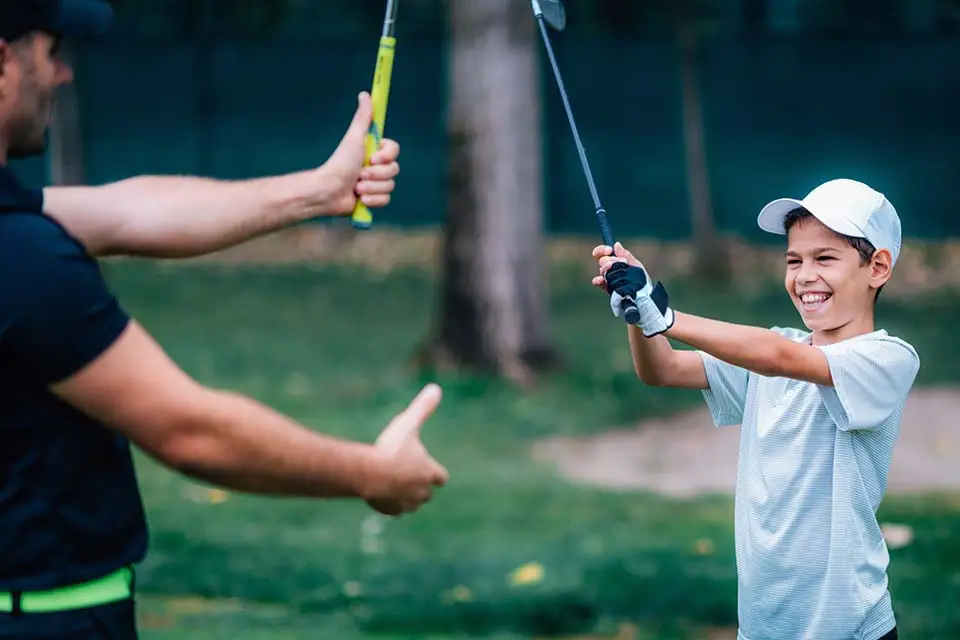
1. Start the downswing with the lead hip, not the hands
Feel the lead hip bump toward the target while the club is still at the top. Then turn. The chest has to keep rotating until it faces left of the target (right-hander). If your belt buckle is still pointing at the ball at impact, the wing is already happening. A useful thought from players who have beaten this: keep the trail foot down a beat longer so you cannot spin out, then let it release.
2. Connection drill — glove under the lead arm
Tuck a glove or headcover under the lead armpit. Make half-swings, then three-quarter, then full. The object should survive until after impact. If it dumps at the ball, you disconnected. This is the fastest feedback drill I know and it works on a carpet. Golfocity’s version adds the same idea with a more aggressive lower-body bump. Do both.
3. Hit down on a mid-iron, on purpose
Put a tee an inch in front of the ball and try to clip it after the ball. That forces the low point forward. Chicken-wingers cannot do this until they rotate, because a bent lead elbow raises the handle and the club bottoms out early. Ten balls, 8-iron, no driver until you take a divot in front of the ball.
4. Neutral-to-slightly-stronger lead-hand grip
See two knuckles on the lead hand at address. A three-knuckle grip can close the face too fast and create a hook you then try to steer. A zero-knuckle weak grip is the more common chicken-wing partner — you flip to save the slice, and the elbow pays for it. Grip pressure: hold a tube of toothpaste, not a hammer.
5. Split-hand or pump drill for sequence
Take a 9-iron, slide the trail hand down an inch, and make slow-motion swings focusing on the chest turning past the ball while the lead arm stays long. Then put the hands back together and keep the same sequence. If you have a partner, have them hold a club shaft across your trail hip as a “gate” you have to turn around, not bump into.
6. Finish like you mean it
A real finish: belt buckle at the target, lead arm folded across the chest (not out to the side), trail shoulder closer to the target than the lead shoulder, weight on the lead heel. Hold it until the ball lands. Players who wing it cannot hold a finish because they never rotated onto the lead side. The pose is the diagnostic.
7. Film it, then get a second set of eyes
Down-the-line video at 240 fps on a phone is enough. If you cannot see the lead elbow staying closer through impact, you do not have a feel problem, you have a sequence problem. A good coach will usually put you on a rehearsal of hip-then-chest rather than an “elbow drill” for 40 minutes. If you are also losing contact entirely — the “I had a swing on Tuesday” feeling — that is a different pile, covered in why you suddenly cannot hit a golf ball.
What not to do
Do not pin the lead arm against the body and freeze it. Golf needs the lead arm to fold after impact, just not at the ball. Do not roll the forearms violently to “turn it over” — that is a hook factory. Do not move to a giant game-improvement iron and call it a fix; a more forgiving face will hide some of the distance loss, but the wing will still leak shots right. If you want more help from the head itself, that is a club conversation we already had in what game improvement irons actually do.
And skip the Instagram of a random swing tip that does not show impact. The Chris Ryan video above is in the post because it shows the lead arm through the ball, which is the only frame that matters.
A simple range session that actually changes it
- 10 slow 9-iron swings, glove under the lead arm, waist high to waist high.
- 10 balls with the tee-in-front-of-the-ball low-point drill.
- 10 balls at 70% speed, hold the finish for three seconds.
- 10 balls at normal speed, same finish. If the wing comes back, drop to 70% again.
Do not add driver. Driver lets you hang back and still hit the ball. Irons do not. When the 8-iron starts taking a divot in front of the ball, the wing is leaving.
FAQs
Is a chicken wing the same as a flying elbow at the top?
No. A flying trail elbow at the top is a backswing look. The chicken wing is the lead elbow breaking down through impact and into the follow-through. You can have one, the other, or both. They get coached differently.
Can a chicken wing cause a slice?
It can. A stalled body plus a flipping face often leaves the face open to the path, which is a fade or slice. It can also produce a low pull-hook if the flip closes the face. The common denominator is poor compression, not one ball flight.
Will stronger wrists fix it?
Wrist strength is not the limiter. Tour players chicken-wing on bad days too when they hang back. Sequence first. If you have actual pain in the lead elbow, that is a medical issue — see our KT tape for golfer’s elbow and Flexbar pieces, and get it looked at if it lasts.
How long does it take to lose the wing?
The glove drill can clean up impact in a single range session at 70% speed. Making it stick on the course, with a driver in your hand and a tight lie, is a couple of weeks of the session above, not a weekend miracle. Film once a week so you do not drift.

Hi, my name is Vince Richmond and I am the owner of earlygolfer.com. This blog is all about golfing, from tips and tricks to equipment reviews and everything in between. I have been golfing for over 20 years now and love the sport more than ever. I am always looking to improve my game and help others do the same. When I’m not golfing, I can be found spending time with my wife and two kids or playing some other sport (I’m a bit of a sports junkie). Thanks for reading and be sure to check out earlygolfer.com for all your golfing needs!

![How To Make Money Playing Golf: [7 Ways To Get Paid]](https://earlygolfer.com/wp-content/uploads/2022/10/How-To-Make-Money-Playing-Golf-768x512.jpeg)